
Schoolstraat 29
Open van 11.00 – 16.00 uur

Deze voormalige boerderij herinnert eraan dat Wassenaar van oorsprong een boerendorp was. In de oude kern stonden boerderijen, naast de woningen van middenstanders als de smid, de wagenmaker, de bakker en de bierhandelaar. De Schoolstraat behoort tot de middeleeuwse straten die vanaf het Plein uitwaaieren, te weten de Berkheistraat, de Gang en de Langstraat.
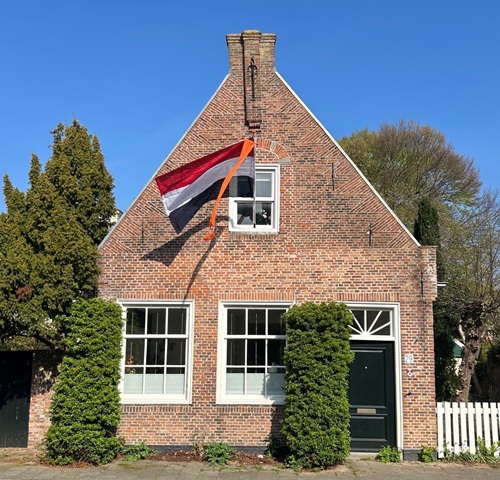
Het tegenwoordige pand Schoolstraat 29 stamt uit de eerste helft van de zeventiende eeuw. Een mooi detail uit die tijd is het renaissance-boogje in de voorgevel, boven het raam van de zolderverdieping. Uit oude archiefstukken blijkt dat op deze locatie al eerder een huis stond. De ouderdom van het huidige huis is ook enigszins te bepalen via details als het gebruikte baksteenformaat, een oud keldertje en twee zeventiende-eeuwse consoles die enkele zolderbalken ondersteunen. Voor zover na te gaan woonden er boerenfamilies in het huis. Het wordt in 1770 omschreven als een ‘bouwhuijs’ (boerderij) met twee hooibergen, koe- en paardenstallen en schuren.
In 1932 kreeg het huis een nieuwe functie. De voorkamer werd in gebruik genomen als sigarenwinkel. Daartoe werd in de voorgevel een etalageruit gezet, met links daarvan een schuin geplaatste winkeldeur. Het raam van de opkamer rechts in de gevel werd dichtgemetseld (op deze hoogte zit nu de voordeur). Tot die tijd stond links voor het huis een vierkante uitbouw die waarschijnlijk diende als bakhuis en later als keuken. Via dit gebouwtje kwam men het huis binnen. Het werd in 1932 afgebroken.
In 1955 kocht de gemeente Wassenaar het pand. De gemeente had een plan ontwikkeld om de oude kern van het dorp te saneren, waarbij veel van de historische bebouwing vervangen zou worden door nieuwbouw. Ook de voormalige boerderij zou gesloopt worden. De gemeenteraad ging akkoord, maar de Raad van State floot de gemeente terug. In overleg met de Rijksdienst voor de Monumentenzorg besloot de gemeente vervolgens het oorspronkelijke karakter van het huis te herstellen. De winkelruit en –deur maakten plaats voor de huidige ramen en een stijlvolle voordeur. De twee ramen zijn afkomstig van een boerderij in de Langstraat die in het kader van de sanering moest verdwijnen.
In 1983 liet de gemeente een nieuwe renovatie uitvoeren door het architectenbureau ir. J.H. Kooreman en ir. J.J. Raue in Delft. Daarbij werd het achterhuis afgebroken, evenals een deel van de tuinmuur naast het huis. Dit werd gedaan om een doorgang te creëren van de Schoolstraat naar een nieuw aangelegd parkeerterrein achter het huis.
In 2024 verkocht de gemeente het huis aan twee particulieren. Het pand had inmiddels, na bewoond te zijn geweest door Oekraïense vluchtelingen, wel weer een opknapbeurt nodig. Het werd in opdracht van de nieuwe bewoners zeer zorgvuldig gerestaureerd, waarbij historische details goed bewaard zijn gebleven.
Tekst: Albert Clobus en Robert van Lit
Former village farm
Schoolstraat 29
Open from 11 a.m. – 4 p.m.

This former farm is a reminder that Wassenaar was originally a farming village. In the old centre there were farms, next to the homes of middle-class people such as the blacksmith, the wheelwright, the baker and the beer merchant. The Schoolstraat is one of the medieval streets that radiate from the Plein, namely the Berkheistraat, the Gang and the Langstraat.
The current building Schoolstraat 29 dates from the first half of the seventeenth century. A beautiful detail from that time is the Renaissance arch in the front facade, above the window of the attic floor. Old archive documents show that a house already stood at this location. The age of the current house can also be determined somewhat via details such as the size of the bricks used, an old cellar and two seventeenth-century consoles that support some attic beams. As far as can be determined, farming families lived in the house. In 1770 it was described as a ‘bouwhuijs’ (farm) with two haystacks, cow and horse stables and barns.
In 1932 the house was given a new function. The front room was put into use as a cigar shop. For this purpose a display window was placed in the front facade, with a shop door placed diagonally to the left of it. The window of the upper room on the right in the facade was bricked up (the front door is now at this height). Until then there was a square extension on the left in front of the house that probably served as a bakehouse and later as a kitchen. The house was entered through this building. It was demolished in 1932.
In 1955 the municipality of Wassenaar bought the building. The municipality had developed a plan to renovate the old core of the village, whereby many of the historic buildings would be replaced by new construction. The former farm would also be demolished. The municipal council agreed, but the Council of State whistled the municipality back. In consultation with the National Monuments Agency, the municipality then decided to restore the original character of the house. The shop window and door made way for the current windows and a stylish front door. The two windows come from a farm in the Langstraat that had to disappear as part of the redevelopment.
In 1983, the municipality had a new renovation carried out by the architectural firm ir. J.H. Kooreman and ir. J.J. Raue in Delft. The rear house was demolished, as well as part of the garden wall next to the house. This was done to create a passage from the Schoolstraat to a newly constructed parking lot behind the house.
In 2024, the municipality sold the house to two private individuals. The building, after having been inhabited by Ukrainian refugees, was in need of renovation again. It was very carefully restored on behalf of the new residents, with historical details being well preserved.
Text: Albert Clobus and Robert van Lit
 Open Monumentendag Wassenaar