


Program Open Monuments Day Wassenaar 2023
Guided tours are given at a number of Open Monuments; listed below are the tours that start at specific times
OPENING
10:00 – 10:30 Walk-in for the Opening (corner Van Hogendorpstraat/Tuinpad/Achterweg) with music by Tadik van Wijngaarden and Ellen Kapel
10:30 – 11:00 Opening with the mayor and the chairman of the Committee Open Monuments Day Wassenaar
GUIDED TOURS, STORYTELLERS ETC.
11:00 – 11:45 Walk with the mayor to monuments in the center of Wassenaar
11:00 – 16:00 Monuments are open (see route map for details); for exact opening hours, see description of the monument on the website.
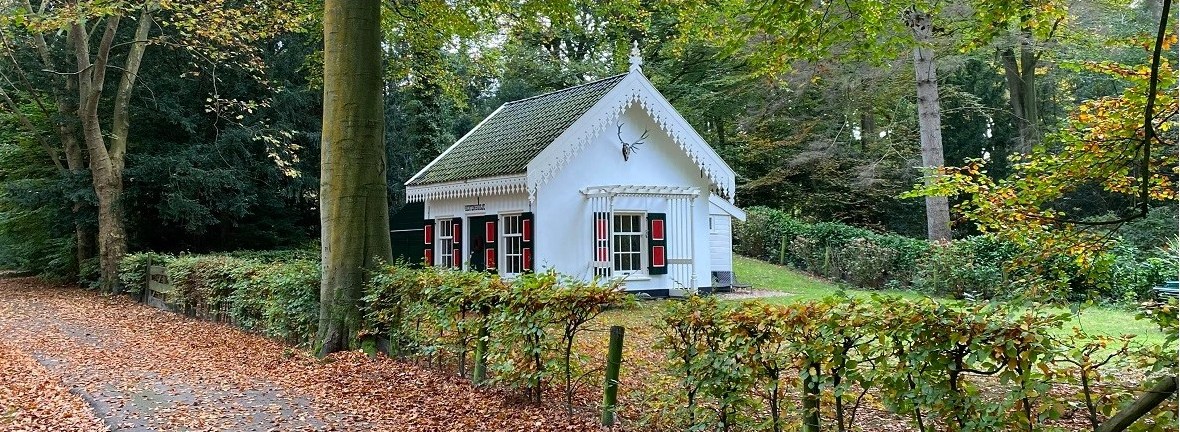
11:00 – 16:00 Deer house – continuously a Storyteller present – (see also #VerhalenvertellersWassenaar on Instagram about storytellers at this and other locations about the Canon of Wassenaar)
11:00 – 15:00 Bunker complex Rijksdorp – guided tour/visit takes approximately 20 – 30 minutes
11:00 -12:00 Storytellers in the Prinsessetuin next to Town Hall de Paauw
11:00 Guided tour Town Hall de Paauw
11:00 Landgoed Backershagen – storyteller (start at the Deer House)
12:00 Guided tour Town Hall de Paauw
12:00 Wavo park – storyteller
12:00 Landgoed Backershagen – storyteller (start at the Deer House)
13.00 Lecture about De Paauw in Town Hall de Paauw (Trouwzaal)
13:00 Wavo park – storyteller
13:00 Landgoed Backershagen – storyteller (start at the Deer House)
14:00 Guided tour Town Hall de Paauw
14:00 Wavo park – storyteller
14:00 Landgoed Backershagen – storyteller (start at the Deer House)
15:00 Guided tour Town Hall de Paauw
15:00 Wavo park – storyteller
15:00 Landgoed Backershagen – storyteller (start at the Deer House)
Exhibitions:
- Fire brigade museum (in Town Hall de Paauw)
o Reception on the occasion of 100th anniversary at 15:00 hrs - Deer House (’t Hertenhuisje)
- Gallery De Graanschuur (next to the mill) – exhibition about the mill
Activity for children:
- Ars et Studium in Gallery De Graanschuur – drawing for children
Route
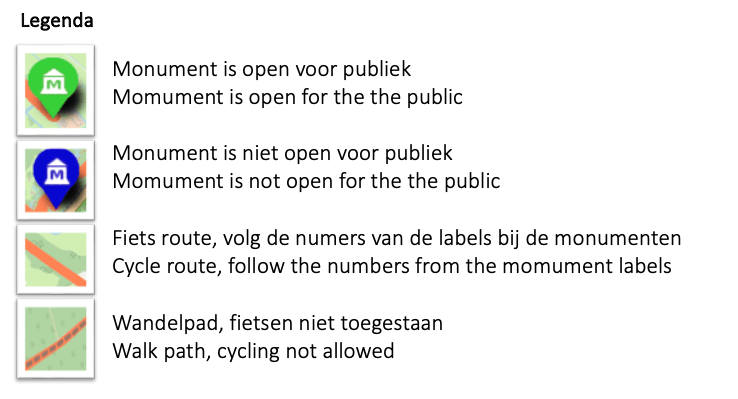
Cycling Tour Open Monuments Day 2023
- Garden Baljuwhuis Bailiff’s House, Plein 1 (Open Monument- see description under tab Monuments)
- Wasnarhoeve, van der Doeslaan 1. This villa was built in 1928 on part of the former Rijksdorp country estate, which dates from the seventeenth century. The architect was Frans Stam from Dordrecht, who built for Gerardus Daniel van Es Gips, also a Dordrecht wood merchant. Many types of wood have been used in the house, which is somewhat reminiscent of a seventeenth-century farmhouse. After the Second World War, the house served as a youth hostel for a while and later as a police academy. It is now a residential house again.
- Rijksdorp bunker complex, Van der Doeslaan (Open Monument see description under tab Monuments)
- Bellesteyn Farm, Oostdorperweg 197. The site of this farmhouse was already built in 1472, which is described as a house with canals and an orchard. It was a fortified house that served as a country estate in the seventeenth century. In the current farmhouse, seventeenth-century masonry is still hidden behind a layer of plaster. In 1806, the living area was given its present appearance through a major renovation. Bellesteyn had already been in use as a farm for a number of years. It now serves as a residence and riding school.
- Johannushoeve, Oostdorperweg 208 (Open Monument see description under tab Monuments)
- Oostdorperhoeve, Oostdorperweg This long-gabled farm dates from the eighteenth century. The farm was extensively renovated in the twentieth century and used as a villa. This was followed by several restorations and the old appearance of the farm was reconstructed. The Oostdorperhoeve is now used for festive and more serious gatherings.
- Ter Weer farm, Deijlerweg 153. From behind the fence, you can see the former living area of the farm, which dates back to the sixteenth century. The farm belonged to a small castle, the Huis ter Weer, which stood directly south of the farm. The castle was demolished in 1738. Farming in the castle farm ended in 1978. A youth center was later established. Today the former farm is an annex of the American School.
- Theepaviljoen, Tea pavilion De Horsten, Papeweg (Open Monument see description under tab Monuments)
- Former coach house of De Paauw. Prince Frederik of the Netherlands (1797-1881), son of King Willem I, lived in the De Paauw house, the current town hall. In 1845 the prince had this coach house built, where his carriages and horses could be parked and where the coachman lived. The u-shaped building served as a fire station from 1945 to 1990. Then it was converted into a luxury apartment complex.
- Raadhuis De Paauw, Raadhuislaan 22 (Open Monument see description under tab Monuments)
- Backershagen, Backershagen Estate. The white country house, which is located on private land, is a modern replica of the Backershagen country house from 1730. The founders of the country house were Cornelis Backer and Maria Clara van der Hagen. After World War II, the house served as the official residence of the Indonesian ambassador. After several years of vacancy, the house burned down in 1974. The reconstruction, with the addition of two apartment buildings, was completed in 1987.
- Hertenhuisje, Deer House (Open Monument see description under tab Monuments)
- Theekoepel, Tea dome Backershagen. This monumental dome was built around 1770 on the Backershagen country estate. The hill on which the dome stands was raised by workers. In the dome, the Backers could receive their guests and let them enjoy the view of the surrounding park and the wider area. C. Johan Kieviet, author of the bestseller Dik Trom, wrote a children’s book about the ‘Mysterious dome’, which (also in reality) had a secret door.
- Villa Rust en Vreugd, Rest and Joy. This white villa from 1923 stands on a water feature along the Van Ommerenlaan. The client was the Rotterdam shipowner Philippus van Ommeren, the architect was Samuel de Clercq.
- Farm De Raaphorst, Raaphorstlaan 18 (Open Monument see description under tab Monuments)
- Oud Wassenaar Castle, Oud Wassenaar Park. The extremely wealthy rentier Cornelis Jan van der Oudermeulen had this castle built in 1876-1879, which was inspired both by sixteenth-century castles on the Loire and by Dutch town halls (stepped gables) from the Golden Age. A vast park with a water feature was created around the castle. After the death of Van der Oudermeulen in 1904, the castle was sold by his heirs. In 1910 it opened its doors as a hotel. About forty years ago, apartment buildings were built on the site and the castle became a party center.
- Frisia State, Lindelaan 2. If you look through the entrance gate, you will see the coach house annex garage, which is now used as a home. The main building is on the right. Frisia State was built in 1910 for the Rotterdam tobacco merchant E.P. de Monchy. The architects were Zacharias Hoek and Johannes Thomas Wouters, who together had an architectural firm in The Hague. Wouters would later emerge as a project developer and develop various residential areas in Wassenaar. Frisia State served as a children’s home for a while and then became a residential home again.
- Villa De Gijselaar, Stoeplaan 1. This villa was built in a very traditional way as a classic country house in 1927. The client was jhr.mr. Nicolaas Charles de Gijselaar, who apparently appreciated stylish, classic surroundings. The current owners have had the house restored in an exemplary manner and have therefore received the municipal Monument Prize for their efforts.
- De Wittenburg Castle, De Wittenburg Estate 1. Jhr. Helenus Marinus Speelman, descendant of a governor-general of the Dutch East Indies, was able to build this castle between 1899 and 1901 from ample funds. It arose on a country estate that was called the Groot Hoefijzer in the seventeenth century and later. De Wittenburg strongly resembles Zuylestein Castle near Leersum where Mr. Speelman had previously lived. The architect was J.J. van Nieukerken who was assisted by his two sons. To create an ‘old Dutch’ effect, the interior was decorated with seventeenth-century elements (such as fireplaces) that had been removed from historic buildings. Today, the castle is a reception center, restaurant and hotel.
- House Kropholler, Zijdeweg 5. The architect A.J. Kropholler, known as a representative of the traditional Delft School, built this modest villa for himself in 1922. With its rod-divided windows, exterior shutters and thatched roof, it has become a typical Dutch home.
- Koffiehuisje, Small Coffee House, Buurtweg/corner Zijdeweg. Around 1900, lemonade manufacturer Theodoor van Keeken had several of these identical wooden kiosks built in and around The Hague, designed by Frederik Arnold Koch. Here you could buy non-alcoholic drinks. This example was also followed elsewhere in the Netherlands. There were several of these consumption tents in Wassenaar. This kiosk on Buurtweg is the only one that has been preserved.
- Voorlinden, Buurtweg 90 (Open Monument -see description under tab Monuments)
- Former Post office, Groot Haesebroekseweg 55a, 55b, 57. In 1927, the government architect G.C. Bremer designed this auxiliary post office (the head office was on the Lange Kerkdam). The architectural style is clearly adapted to the residential area where the post office was located. It has been used as a residence for a long time. After a long period of neglect, the property has recently been restored and modernized inside.
- WAVOpark, Schouwweg 81. Mr and Mrs Van Ommeren have lived on the Rust en Vreugd estate since the early twentieth century. In the 1920’s they decided to do something about the destitute circumstances in which some of their acquaintances had found themselves. They commissioned architect Samuel de Clercq to build a monumental apartment complex for couples who had run into financial difficulties through no fault of their own. The WAVOpark, which was realized in 1928, takes its name from Wilhelmina Alida Van Ommeren, one of the two founders of the residential complex.
- Johannahuis, Mayor Schoutepark. This residential complex was also built by architect Samuel de Clercq on behalf of the Van Ommeren couple. The main building on the Schouwweg side has the appearance of an English country house. It was completed in 1931 and was intended to house single ladies. It has been recently restored and divided into luxurious apartments.
- Meyland, Backershagenlaan 17-21 (Open Monument see description under tab Monuments)
- Garage with upstairs apartment, Schouwweg. The garage is part of the Ter Veken estate. The core of this is the country house from 1908, which can be reached from the Schouwweg via an entrance gate, a stone bridge and a driveway. The car shed, built in 1911, is located on the Schouwweg, with the home of the private driver and his family above it. The client of the villa was the banker N.W. van Es, the architect was L.A.H. de Wolf, which has mainly made a name for itself with the construction of luxury retail properties.
- Sint Willibrorduskerk, church, Kerkstraat This Roman Catholic church was built in 1904, replacing a much smaller church building. The building was built in a neo-Gothic style after a design by the architect Nicolaas Molenaar. In fact, a Catholic ensemble was created on the Kerkstraat: next to the church, a large presbytery (now used as a hospice), a patronage building (now the Warenar cultural center), a monastery (now an apartment complex) and a school (now St. Bonifacius School).
- Muziektent, Bandstand on Burchtplein. Architect Co Brandes built this monumental bandstand in 1930 in the style of The Hague School in a newly landscaped park. The bandstand was built on the spot where a hill used to be in the meadow. A medieval castle once stood on this hill, which is considered to be the ancestral seat of the noble Van Wassenaer family.
- Molen, Mill Windlust, Molenplein (Open Monument see description under tab Monuments).
- Grutterij/slager, Former grocer’s shop/butcher’s shop, Langstraat 29 (Open Monument see description under tab Monuments)
- Karrenschuur, Cart shed, at Gang 9 (Open Monument see description under tab Monuments)
- Dorpskerk, Village Church, Square. About a thousand years ago, a small Romanesque church was built in stone on the site of the current church. A piece of wallwork from this church can still be seen on the north side of the church building. This stone church may have had a wooden predecessor. In later centuries the church was enlarged and embellished. In July 1573, however, the church was heavily damaged during the Eighty Years’ War: only the walls remained standing. The choir (in fact the most important part of a Catholic church) remained a ruin to this day. The originally Catholic church was now used by the Reformed who provisionally restored the building. It was only during a major restoration in 1938-1940 that the church building largely regained its former glory.
 Open Monumentendag Wassenaar